

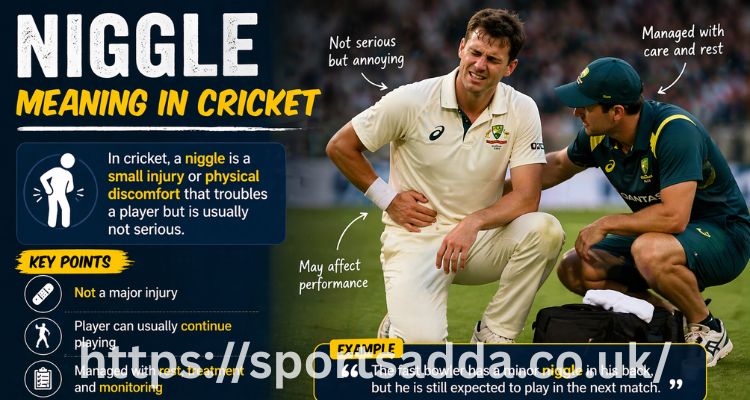
Niggles are an unfortunate aspect of cricket. While they might not stop players from playing, niggles increase the risk of serious injury three to six times!
Hamstrings go ping mid-sprint, backs stiffen after bowling loads and shoulders grind with endless throws – these injuries are among the many hazards faced by cricket players who try their luck in tournaments. To reduce injuries caused by playing cricket, experts suggest building strength through building programs, managing workloads effectively and employing recovery tools. Here we will discuss about the niggle meaning in cricket and other details about cricket.
Batting
Batting in cricket can be an extremely physically demanding sport. With 22 players participating and fast movement, agility, and decision-making required in order to score runs – placing significant stress on lower body and core muscles as well as demanding a high level of fitness and flexibility – injuries are an all too frequent occurrence in this game.
Cricket players face rigorous physical demands as well as the stressors associated with everyday life, which makes their schedule hectic and demanding. Therefore, regular check-ins with their medical team to monitor injury risks is vitally important. A medical professional should never dismiss minor concerns as minor; rather they should investigate further into how training load, nutrition or sleep patterns might be contributing factors.
As part of any plan to address niggles, listening carefully to a cricketer’s complaints is paramount. One effective method for doing this is using the Oslo Sports Trauma Research Centre questionnaire which allows them to openly discuss any symptoms they’ve encountered during training or matches and communicate this to medical staff so they can quickly determine their true cause.
Cricket batters can use creative shots called horizontal bat strokes such as cuts, square drives, pulls and hooks to score runs in any direction and use creative shots such as horizontal bat strokes to score runs and score runs. Horizontal bat strokes often require batters to swing their entire bat at the ball for extra strain on muscles and joints.
One of the more frequent cricket injuries is groin strain, caused by repeated hip flexion and twisting movements necessary for play. This movement often results in chronic groin issues if left unaddressed.
Another common cricket injury is shoulder pain, caused by repetitive throwing motions required for playing the sport. This may result in tendinitis of the rotator cuff or other upper extremity injuries; therefore cricketers must focus on strengthening and conditioning of their shoulders and rotator cuff in order to prevent such incidents from occurring.
Bowling
Bowling in cricket refers to the act of delivering the ball to a batter. A skilled bowler can manipulate both line and length of each delivery in order to make it difficult for batsmen to attack the pitch; for instance by shortening and widening off stump deliveries which remove many attacking options for batsman like straight shots; bowlers also must strike at an acceptable length so the ball does not come too close for too much stepback play on half volley shots.
Bowlers use various techniques to disarm batters, such as altering the angle of seam, rotating the ball away from batsman or bowling a googly. A googly involves holding the ball similarly to an off spinner but rotating fingers and wrist anticlockwise at release, creating spin that moves it from leg to off leg. Another variation includes top spinner, where both leg break and googly bowlers hold thumb towards batsman at time of release – creating yet more diversion for batters!
Fast bowlers can be highly effective at restricting scoring opportunities for batters, yet are not always successful at dismissing them outright. This may be partly due to bowling too many overs, causing batter fatigue that leads them to misjudge deliveries when they arrive – something a trained batter could exploit quickly to score runs quickly between the creases.
Skilled bowlers know this, so they frequently alter their line and variations, using different kinds of deliveries with the goal of trapping batters into specific rhythms and knocking them out. Sometimes this includes setting off multiple preplanned deliveries that all aim to deliver one final blow against them at the same time – which may or may not succeed!
Fielding
Fielding is an integral component of cricket and most other sports, and its language can be confusing if you’re new to either sport or helping young players learn it. But with just a bit of knowledge you’ll understand when commentators use phrases like “silly point is slightly wider than normal” or “third man is too close”.
Fielding positions in cricket include many diverse and descriptive names for each position, which generally correspond with its respective role relative to batter. Some examples are slip, gully, point, long on, short leg, third man and mid off; additional fields may also be deployed depending on pitch conditions, weather and bowler type.
Fielders at each position will depend heavily on both captain’s strategy and batter ability. For instance, fast bowlers might deploy an aggressive field that features multiple slips and gully to increase chances of catching mishit shots, while spin bowlers could employ similar strategies that include adding fielders at silly point and short leg to prevent runs being scored freely from mishit balls.
Niggle is an often-heard word in cricket and other sports, but should not be mistaken for an injury. While these niggles may not be serious in themselves, they do limit one’s performance at their optimal levels and can increase risk by three to six fold in comparison with playing fully fit players. Studies have revealed this correlation.
Though niggles may not be as severe as injuries, it’s still essential for players to report them to their trainers or coaches as soon as they occur. A physiotherapist is best qualified to assess and treat such discomfort to ensure players can continue competing at their optimal level; having one assess and treat niggles could prevent worsening that may lead to more serious injury down the road; additionally they assist with rehabilitation processes to help players return quickly back into competition.
Workload Management
Workload management is an essential aspect of cricketer career success, balancing match demands with training and recovery needs. Niggles that persist can become serious injuries if ignored; additionally, these problems may compromise performance during batting or bowling sessions and can negatively impact on performance levels overall. Therefore it is critical that athletes report any minor discomfort they are experiencing to a physiotherapist as this can have a direct bearing on injury risk reduction.
No matter the duration, niggles will impede players from participating and increase the risk of serious injury. With cricket’s demanding physical demands continually pushing players beyond their limits, niggles are inevitable – batters put undue strain on lower body muscles while fast bowlers need explosive leg and arm strength in order to deliver balls at high speeds – therefore managing workload effectively is vital to long-term career longevity in cricket.