

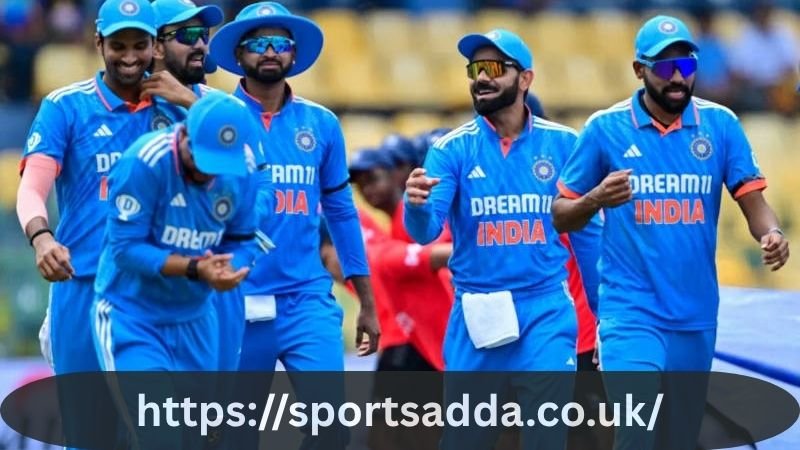
India’s national cricket team, overseen by the Board of Control for Cricket in India (BCCI), is widely considered one of the world’s most competitive. Renowned for their explosive batting, deadly bowling, and precise fielding tactics, its success has made this squad one of fans’ favorites across all cricket markets worldwide.
| No. | Player | Role | Batting Style | Bowling Style |
|---|---|---|---|---|
| 1 | Shubman Gill (Captain) | Opening Batter | Right-hand Bat | Right-arm Off Break |
| 2 | Rohit Sharma | Opening Batter | Right-hand Bat | Right-arm Off Break |
| 3 | Virat Kohli | Top-order Batter | Right-hand Bat | Right-arm Medium |
| 4 | Shreyas Iyer | Middle-order Batter | Right-hand Bat | Right-arm Leg Break |
| 5 | KL Rahul | Wicketkeeper Batter | Right-hand Bat | — |
| 6 | Rishabh Pant | Wicketkeeper Batter | Left-hand Bat | — |
| 7 | Sanju Samson | Wicketkeeper Batter | Right-hand Bat | — |
| 8 | Suryakumar Yadav | Batter | Right-hand Bat | Right-arm Medium Pace |
| 9 | Tilak Varma | Batting All-rounder | Left-hand Bat | Right-arm Off Break |
| 10 | Hardik Pandya | All-rounder | Right-hand Bat | Right-arm Fast-Medium |
| 11 | Axar Patel | All-rounder | Left-hand Bat | Left-arm Orthodox Spin |
| 12 | Ravindra Jadeja | All-rounder | Left-hand Bat | Left-arm Orthodox Spin |
| 13 | Washington Sundar | All-rounder | Left-hand Bat | Right-arm Off Break |
| 14 | Nitish Kumar Reddy | All-rounder | Right-hand Bat | Right-arm Medium Fast |
| 15 | Kuldeep Yadav | Bowler | Left-hand Bat | Left-arm Chinaman |
| 16 | Jasprit Bumrah | Bowler | Right-hand Bat | Right-arm Fast |
| 17 | Mohammed Siraj | Bowler | Right-hand Bat | Right-arm Fast |
| 18 | Mohammed Shami | Bowler | Right-hand Bat | Right-arm Fast |
| 19 | Arshdeep Singh | Bowler | Left-hand Bat | Left-arm Fast-Medium |
| 20 | Harshit Rana | Bowler | Right-hand Bat | Right-arm Fast |
| 21 | Prasidh Krishna | Bowler | Right-hand Bat | Right-arm Fast |
| 22 | Mukesh Kumar | Bowler | Right-hand Bat | Right-arm Medium Fast |
| 23 | Varun Chakravarthy | Bowler | Right-hand Bat | Right-arm Leg Break (Mystery Spin) |
| 24 | Yashasvi Jaiswal | Opening Batter | Left-hand Bat | Right-arm Leg Break |
| 25 | Ruturaj Gaikwad | Opening Batter | Right-hand Bat | Right-arm Off Break |
India is one of the world’s most competitive teams
India has made its mark on international cricket with dynamic batting, deadly bowling and tactical fielding that have set it apart from rival nations. A full member nation of the International Cricket Council with Test, One Day International (ODI), Twenty20 International (T20I), and Twenty20 International status respectively; its strategic development, talent cultivation, global success and talent retention make India among the premier teams globally with notable trophies, records and player milestones to its name.
India first hosted an international match at Lord’s in 1932, yet it took nearly two decades before winning their inaugural Test series victory. Beginning with Sunil Gavaskar in 1971 – first batsman ever to reach 10,000 Test runs – and Rahul Dravid who led India to victory outside of subcontinent (2-0 Test series win in England in 1983), players such as Sunil Gavaskar were instrumental in helping build strength within the team during this era.
India was victorious at its inaugural ODI World Cup title match in 1984 and went on to claim three more in 1985, 1987, and 1995. Their success in limited-overs cricket led to the introduction of the Indian Premier League. Unfortunately for India however, performance in Test matches remained inconsistent as evidenced by poor showings at 1998 Champions Trophy and 1999 World Cup competitions and Azharuddin relinquishing captaincy to Sachin Tendulkar by late 1996 due to team inconsistency.
Dhoni first rose to fame as captain of India’s limited-overs team in 2007, leading them to victory at the inaugural ICC T20 World Cup and later going on to claim three more ICC trophies; 2011’s ODI World Cup win, 2014 ODI World Cup triumph, 2016 Asia Cup trophy victory – making him the only player ever to do so! He also twice topped ICC Test rankings as well as becoming its highest scoring batsman ever. Dhoni serves as an exemplar role model and inspiration; his leadership vision and commitment have set high standards that others should strive to meet.
Dynamic batting
India National Cricket Team is one of the world’s premier teams in cricket. Boasting passionate supporter and highly skilled players, they have transformed global cricketing landscape with strategic innovations and strong leadership. India National Cricket Team’s journey from underdog to powerhouse speaks to their dedication, perseverance and commitment towards excellence.
India has emerged as a global powerhouse in cricket since the late 20th and early 21st centuries thanks to investments in infrastructure, youth engagement, talent development programs and the establishment of the Indian Premier League (IPL), which brought international players and huge financial resources. Along with M.S. Dhoni and Virat Kohli’s dynamic batting style, this has catapulted India to becoming a powerhouse force on the global cricket stage.
In the 1990s, India’s national cricket team struggled to maintain its dominance outside the subcontinent in test matches. Their form waned and they often failed to advance beyond the group stages in several tournaments; this prompted the Board of Control for Cricket in India to hire Anil Kumble as coach; his successful leadership brought back prominence for India’s test cricketers.
Sachin Tendulkar and Anil Kumble greatly strengthened India’s national cricket team when they arrived, improving both batting and fielding abilities, while the rise of Javagal Srinath as India’s fastest bowler further consolidated team strength. India continued their rise during the early 2000s by winning several major ICC tournaments and continuing their rise towards power.
In 1998, India national cricket team participated in the inaugural Champions Trophy tournament, despite a series of poor performances that ultimately propelled them into the semi-finals. That same year they also got selected to participate in the inaugural ICC Twenty20 World Cup tournament.
Over the following years, India National Cricket Team went on to win numerous prestigious tournaments – such as three consecutive T20 World Cup titles in 2010, 2011 and 2022 – cementing its place as a global sports powerhouse with numerous sponsors and a rapidly-expanding fanbase.
Deadly bowling
India is unmatched when it comes to technical bowling precision, as few teams in the world can match India’s bowling attack. Batsmen’s dismissals against India don’t just showcase brute speed or dexterity – rather, their dismissals reveal incredible coordination between fielder and bowler that can dismantle an entire batting lineup in an instant – leaving opponents reeling and video footage being captured as proof.
Rohit Sharma and Prasidh Krishna created an unforgettable moment during their match against Afghanistan. As shown by the lower scoreboard graphic, this moment would go down in social media history. Rohit and Prasidh celebrated with joy on the field while other Afghan squad members looked on in disbelief. According to text below the graphic, Prasidh’s relentless pace and hard lengths found an outside edge every ball; with Rohit’s sharp reflexes in slips making sure every chance was successfully converted.
India’s new fast bowling unit produced a stunning display, taking three wickets without conceding an run, which left Afghan supporters stunned and their fans on Twitter in awe of this elite performance.
India has endured many trials, yet its cricket team continues to flourish and grow into one of the best worldwide. This success can be attributed to young cricketers’ hard work and commitment; India’s national team includes both big city boys and rural aspirants who share a common love of cricket; this diversity must be celebrated rather than undermined through divisive slogans.
Indian cricket team has a rich and impressive legacy, and it will be exciting to witness how its members build on it going forward. Boasting both youth and experience players, India looks set to maintain dominance of international cricket for many years to come.
Tactical fielding
Fielding is a key part of cricket, requiring quick reactions, strong agility and effective communication among players. A skilled fielding team can stop runs from scoring, create run-out opportunities or even turn the tide of battle!
Fielding teams that excel are composed of players who can excel in various positions. From slips, gully, and midwicket through slips and gully to slips and gully they should be comfortable playing any position with ease and read batsmen’s rhythm effectively to determine which position would be most advantageous to their team. In addition, they should possess excellent throwing abilities for taking catches from close quarters.
Viewers enjoy watching fielding from close-in positions because the action is both exciting and intense. However, these positions can also be extremely dangerous as the fielders are only yards from batsman; any edge from his bat traveling quickly towards them increases tension dramatically. A fielding captain will determine which positions should be used on either side of the pitch and how many fielders should be present on each.
Many factors influence this decision, including the tactical situation of a match and which bowler is bowling. Furthermore, the fielding captain must consider factors like wicket condition, weather conditions and lighting conditions when making their call on who should play what position. Certain spots can be more difficult or riskier for fielders than others.
Different formats of the game also place restrictions on how many fielders may be outside the circle at one time; for instance, in an ODI only two fielders may be out between overs 1-10; four is required in T20s to prevent fielding captains from overemphasizing defense and losing games. These restrictions help ensure their fielders focus solely on offense rather than on defense, helping ensure both teams play an even game.
Also Read: