

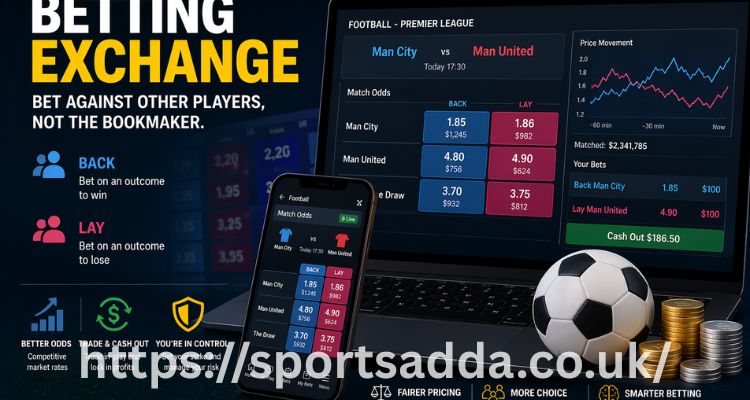
If you’ve ever looked at sportsbook odds and thought, “There has to be a smarter way,” you’re not alone. That smarter way is often a betting exchange. Instead of betting against a bookmaker, you bet against other users. That one shift changes pricing, flexibility, and strategy in a major way. It’s the difference between shopping at a fixed-price store and entering a live marketplace where buyers and sellers constantly negotiate value.
Betting exchanges have evolved from niche tools used by professional gamblers into mainstream platforms attracting traders, sports bettors, and data-driven users. Industry data suggests the global exchange betting segment generated about USD 17.0 billion in 2024 and could reach USD 34.7 billion by 2030, reflecting strong growth interest.
What Is a Betting Exchange?
A betting exchange is an online marketplace where users place bets against one another instead of betting against a bookmaker. The platform itself doesn’t usually set odds like a sportsbook. Instead, odds are created by market demand. If one user wants to back a team at certain odds, another user can choose to lay that same outcome. The exchange earns revenue by charging commission on net winnings rather than embedding a margin into the odds.
Think of it like a stock market for sports outcomes. Buyers and sellers meet, prices move in real time, and value can appear or disappear quickly. This is why betting exchanges attract both casual users and serious traders. Casual bettors may simply want better prices, while advanced users often look for arbitrage, hedging opportunities, or in-play market inefficiencies.
The model became widely known through pioneers such as Betfair and later competitors like Smarkets and BETDAQ. In recent years, exchange-style prediction markets and event-contract platforms have also gained traction globally, bringing the peer-to-peer concept to politics, economics, and entertainment outcomes. That broader trend signals a shift: users increasingly prefer marketplaces over traditional house-set odds.
Core Definition
At its core, a betting exchange allows two sides of the same wager:
- Back Bet = You bet something will happen
- Lay Bet = You bet something will not happen
This dual structure creates far more flexibility than fixed-odds betting.
Betting Exchange vs Traditional Sportsbook
| Feature | Betting Exchange | Sportsbook |
|---|---|---|
| Opponent | Other users | Bookmaker |
| Odds Source | Market-driven | Bookmaker-set |
| Commission | Usually on winnings | Hidden in margin/vig |
| Lay Betting | Yes | Rare |
| Trading Out | Common | Limited |
How a Betting Exchange Works
The magic of a betting exchange lies in its matching engine. When you place a bet, the platform searches for another user willing to take the opposite side at the same odds. If matched, the wager becomes active. If not, it may sit in the market until someone accepts it or the odds move. That means pricing is dynamic, especially before kickoff or during live events.
Imagine a football match where Team A is offered at 2.20 odds. If you believe that price is generous, you can back it. If another user believes Team A is overrated, they can lay it. Once matched, both sides now have exposure. This creates a more efficient market because prices reflect collective opinion rather than one bookmaker’s risk model.
Many exchanges also allow partial matching. If you request a $100 bet and only $40 is available at that price, the rest may wait or be matched at new odds if you approve. This liquidity system is crucial. Large events like Premier League football or horse racing often have deep liquidity, while niche markets can feel thin and slow.
Back Bets Explained
A back bet is the traditional style wager most people know. You stake money on an outcome to happen. If it wins, you profit based on odds. If not, you lose the stake.
Lay Bets Explained
Lay betting is where exchanges become interesting. You act like the bookmaker by betting against an outcome. If the selection loses, you win the other bettor’s stake. If it wins, you pay your liability.
Matching Engine and Liquidity
Liquidity refers to how much money is available in the market. More liquidity usually means:
- Easier bet matching
- Tighter spreads
- Better pricing
- Faster exits during live events
Why Bettors Use Exchanges
The biggest reason bettors migrate to exchanges is simple: better odds. Traditional sportsbooks build profit margins into every line. That hidden tax, often called vig or juice, reduces long-term value. Exchanges usually charge commission only on winning bets, which often still results in better net returns.
For sharp bettors, that difference compounds dramatically over hundreds of bets. A tiny improvement from 1.90 odds to 1.97 odds may look small on one wager, but over a year it can separate profit from loss. It’s like driving with the handbrake slightly raised—small friction adds up.
Another major advantage is flexibility. On many exchanges, you don’t need to wait for the match to end. You can close a position early, lock profit, reduce losses, or reverse your opinion mid-game. If a tennis player starts strong and odds shorten, you can lay them after backing pre-match and secure profit regardless of outcome.
This is why many users no longer see exchange betting as gambling alone. They treat it like market trading with sports as the asset class.
Better Odds
Because users compete against each other, prices can become sharper and more favorable than sportsbooks.
Cash Out and Trading Flexibility
Exchanges often provide superior manual cash-out options because users can trade directly into the market rather than accept a bookmaker’s adjusted offer.
Best Betting Exchange Platforms in 2026
Several platforms dominate discussion in 2026. Betfair remains one of the most recognized names in exchange betting. Smarkets continues to attract users with competitive commission models. BETDAQ still serves a portion of the market, especially among experienced exchange users. Newer prediction-style exchanges have also expanded globally.
Reports in 2026 note that Smarkets has processed over $50 billion in lifetime trading volume, reflecting continued demand for exchange-based betting models.
When choosing a platform, don’t chase branding alone. Look at liquidity in the sports you actually bet. A platform can be famous yet weak in your preferred niche market. Commission matters too. So does interface speed, mobile performance, chart tools, in-play reliability, and withdrawal reputation.
Leading Global Options
- Betfair Exchange
- Smarkets
- BETDAQ
- Regulated event-contract exchanges (region dependent)
What to Look for in a Platform
- Strong liquidity in your markets
- Fair commission structure
- Fast live betting interface
- Reliable withdrawals
- Licensing and regulation
- Good mobile usability
Betting Exchange Strategies
Winning on exchanges requires a different mindset from casual sportsbook betting. You are not only predicting results—you are reading prices. Sometimes the best team is not the best bet. If a favorite should be 1.70 but trades at 1.55, the price may be poor value even if they win often.
Value betting focuses on finding prices above true probability. If you estimate a team has a 60% chance to win, fair odds are around 1.67. If the market offers 1.80, you may have edge.
Scalping means taking small profits from short-term price movement. Traders may back at 2.10 and lay at 2.04 minutes later. Repeated often, these small edges can stack like coins in a jar.
Swing trading involves larger moves. A football team dominating possession may shorten significantly after halftime pressure. Skilled traders anticipate that shift.
Hedging is risk management. If your original bet gains value, you can lay off some exposure and guarantee a return.
Value Betting
The long game is beating probability, not cheering winners.
Scalping and Swing Trading
This requires discipline, speed, and understanding volatility.
Hedging Risk
Protecting bankroll often matters more than maximizing one result.
Risks and Common Mistakes
Betting exchanges reward skill, but they also punish carelessness. The first common mistake is misunderstanding liability on lay bets. New users sometimes risk much more than expected because lay losses can exceed stake amounts. Always calculate liability before confirming.
Low liquidity is another trap. You may enter a market easily but struggle to exit at a fair price. This is especially dangerous in live markets where odds move like quicksand.
Emotional trading is equally costly. Chasing losses after a red card or late goal often leads to poor decisions. Markets move fast, but frustration moves faster. Professionals rely on rules, not mood.
Some users also overtrade. Because exchanges feel interactive, people click constantly. More activity does not automatically mean more edge. Sometimes the smartest trade is no trade.
Low Liquidity Markets
Thin markets can create bad fills and wide spreads.
Emotional Trading
Impulse decisions are expensive tuition fees.
Betting Exchange Legal and Tax Considerations
Legality depends entirely on your jurisdiction. Some countries fully regulate betting exchanges, others restrict them, and some prohibit access entirely. Always check local law before registering. Regulations may also affect available sports, staking limits, and identity verification.
Tax treatment also varies. In some countries, gambling winnings may be tax-free for individuals. In others, profits could be taxable income, especially if trading is systematic or professional in nature. Because rules change, consult a licensed local tax advisor rather than relying on generic online claims.
Platform regulation matters too. Licensed operators must often segregate funds, verify identity, and comply with anti-money-laundering rules. That may feel inconvenient, but it can significantly improve consumer protection.
Future of Betting Exchanges
The next chapter for betting exchanges looks powerful. Industry reports estimate robust growth in exchange betting and wider online wagering markets through 2030 and beyond. Meanwhile, event-contract and prediction exchanges are attracting institutional attention. In March 2026, Intercontinental Exchange, parent of the NYSE, invested $600 million in Polymarket, showing serious capital interest in exchange-style event markets.
Technology will likely push exchanges forward through:
- Faster in-play pricing
- AI-driven analytics tools
- Better mobile trading dashboards
- Global liquidity pools where permitted
- Lower friction deposits and withdrawals
The line between sports betting, financial trading, and prediction markets may continue to blur. Users increasingly want transparent pricing, control, and tradable positions. Exchanges deliver exactly that.
Conclusion
A betting exchange is more than an alternative betting site. It is a marketplace where price matters as much as prediction. By allowing both back and lay bets, offering often better odds, and enabling live trade management, exchanges create opportunities traditional sportsbooks rarely match.
That said, opportunity without discipline becomes risk. Success comes from understanding liquidity, probability, bankroll management, and emotional control. If you approach exchanges like a market rather than a casino, your decisions become sharper and more sustainable.
For casual bettors, exchanges can mean better value. For advanced users, they can become a strategic edge. Either way, knowing how betting exchanges work in 2026 is no longer optional—it’s increasingly part of smart betting literacy.